Avatar Krishna in India
|
Lord Krishna Advents in India: Krishna and Radha (2000 BCE), He came again as Krishna, and transformed obedience into love, God alone is real, that love and selfless service are the quickest path to Him. When the Aryans later migrated into India they brought a structured spiritual language, the Vedic idea of cosmic law. Accepting Rama and Krishna, who were worshiped by local peoples, as manifestations of God. “Whenever there is a decline of righteousness and a rise of unrighteousness, I manifest Myself to protect the good, destroy evil, and restore dharma.”
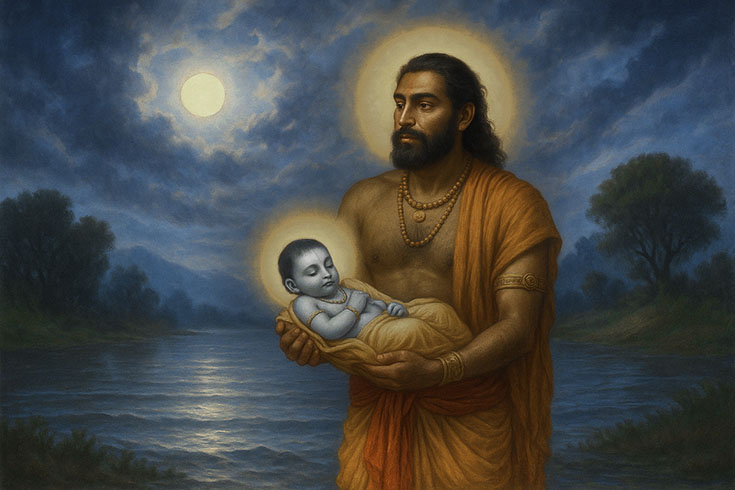
— Bhagavad Gita -- INDIA PILGRIMAGE PAGE INDIA PILGRIMAGE --------------------------------------------- Lord Krishna Krishna – c. 2,000 BCE Under a starry sky heavy with fate, Krishna was born in the prison cell of Mathura, to Devaki and Vasudeva. He was the eighth male child, the one foretold to destroy the tyrant Kansa, Devaki’s own brother, who ruled Mathura with cruelty and dread. The moment the baby appeared, the prison doors opened, the guards fell asleep, and the river Yamuna parted to make way. Vasudeva carried his newborn son across the waters to the village of Gokul, where he was exchanged with the infant daughter of Yashoda and Nanda, the cowherd chief.
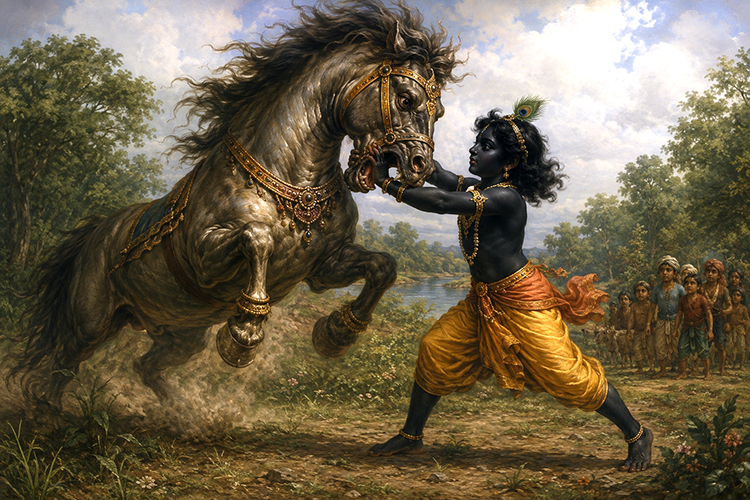
Krishna’s earliest years were marked by miracles and mischief. He crawled through cow dung, stole curds, and enchanted all with his dark-eyed smile. But even as a toddler, danger followed. Kansa, fearing the prophecy, sent demon after demon to kill the child: The giantess Putana, who tried to poison him with her breast milk, fell lifeless as Krishna sucked the very life from her. Trinavarta, a whirlwind demon, carried him into the sky - only to be crushed under the baby’s weight. Others met similar ends, undone by the divine child who seemed no more than a playful boy.
At the age of three, due to growing threats, Nanda moved the entire village to the forested pastures of Vrindavan, on the other side of the Yamuna River. In Vrindavan. Surrounded by forest, river, and cow-dotted meadows, Krishna grew into a radiant youth, full of laughter, grace, and boundless charm. He played the flute under the kadamba trees, and its notes stirred the hearts of all beings: None were more entranced than Radha, older than Krishna by a year or two, was the daughter of Vrishabhanu and Kirti, from the nearby village of Barsana. Her beauty was unmatched, but it was her devotion, her spiritual longing, that set her apart. In every glance she cast upon Krishna, there was recognition - not just of a boy, but of the Divine Beloved.
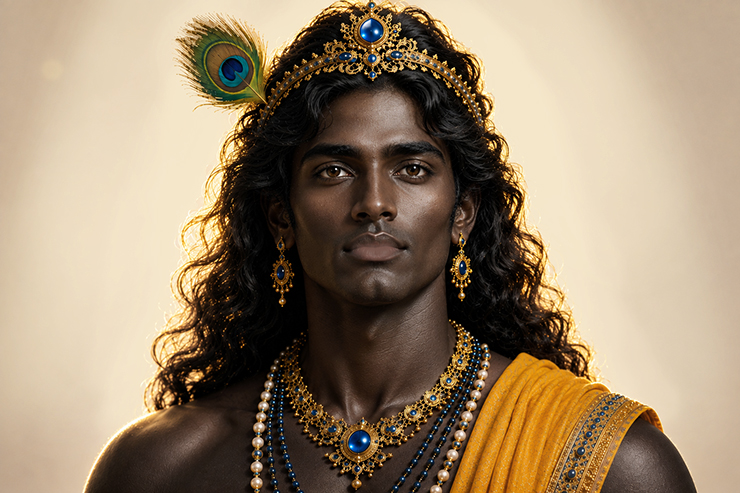
LORD KRISHNA AND RADHA IN VRINDAVAN Their love was not of the world. They met in secret groves, danced in moonlit clearings, and played among the trees - their companionship the highest symbol of bhakti, the path of love and surrender. Radha and Krishna's love story is the ultimate symbol of divine, unconditional devotion in Hindu tradition. Krishna's bond with Radha represents a spiritual love that transcends social norms and marriage. As he grew, Krishna became the guardian of Vrindavan He lifted Govardhan Hill on his little finger to shelter his village from Indra’s wrath. He subdued Kaliya, the many-hooded serpent who poisoned the Yamuna, dancing on its heads until it surrendered. He stole butter, teased the gopis, and laughed with Balarama, but always, there was a deeper purpose behind the play. He was showing the world how to live with joy, how to love the Divine, and how to protect the innocent even in childhood.
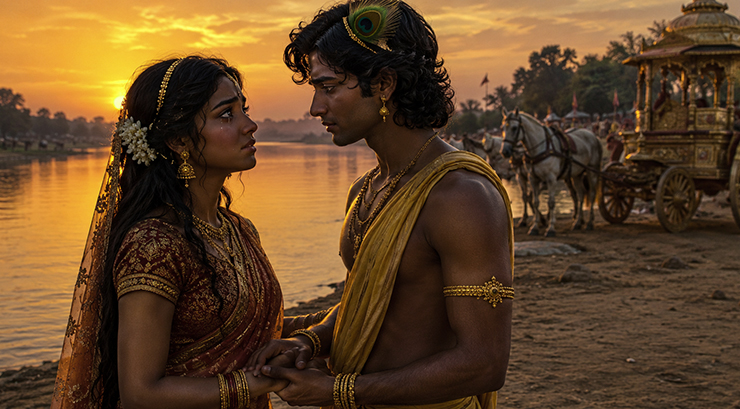
KRISHNA AND BALARAMA LEAVE RADHA AND VRINDAVAN At about the age of seventeen, Krishna left Vrindavan and journeyed to Mathura. The gopis wept, while Radha stood in silent sorrow. Krishna said nothing about whether he would ever return. This separation (viraha) became one of the central themes of later devotional (bhakti) literature. The pain of longing for God came to be understood as one of the deepest expressions of spiritual love. Realizing that all of his previous schemes had failed, the evil King Kansa devised a new plan. He announced a grand festival and wrestling tournament in Mathura and invited Krishna and Balarama to attend. He then sent his trusted relative Akrura, who was secretly a devoted follower of Krishna, to bring the two brothers from Vrindavan. After leaving Vrindavan, Krishna's life changed dramatically. His childhood and youthful years of divine play (lila) came to an end, and a new phase began as prince, statesman, warrior, and spiritual teacher. Krishna killed King Kamsa, freed his parents, Vasudeva and Devaki, who had been imprisoned for many years, and restored Kamsa's father, Ugrasena, to the throne. KRISHNA LEAVING MATHURA
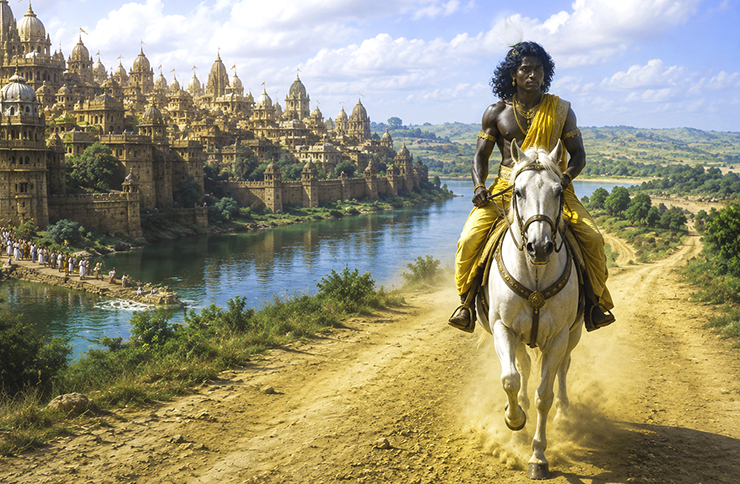
Krishna and Balarama then studied under the sage Sandipani, mastering philosophy, military arts, and many other disciplines in a remarkably short time. Meanwhile, Kamsa's powerful father-in-law, Jarasandha, repeatedly attacked Mathura to avenge Kamsa's death. Although Krishna successfully defended the city time after time, he realized that the constant warfare placed its people in continual danger. Krishna Lord of Dwarka To protect the Yadava people, Krishna has a magnificent fortified city built on the western coast at Dwarka. The population is relocated there, far from Jarasandha's armies. Dwarka becomes Krishna's capital and the center of his later life. The city rose from the sea, said to have been built overnight by divine architects. With golden walls, wide roads, and flowering gardens, Dwarka was both a capital of power and a haven of peace. Krishna ruled there as a prince, guiding his people with wisdom and justice.Dwarkadhish After slaying the tyrant Kamsa, Krishna restored his grandfather Ugrasena to the throne of Mathura. Later, when the Yadavas established the fortified city of Dwarka, Ugrasena remained the official king, while Krishna served as the kingdom's foremost leader, protector, diplomat, and military commander. Often called "Dwarkadhish" (Lord of Dwarka). The Five Pandavas Brothers
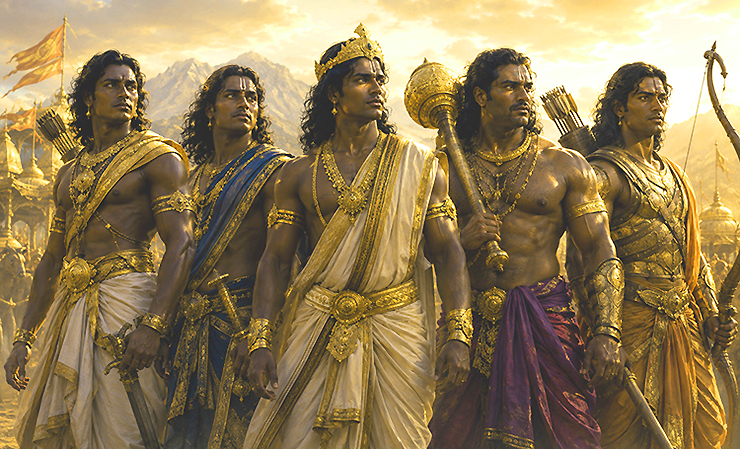
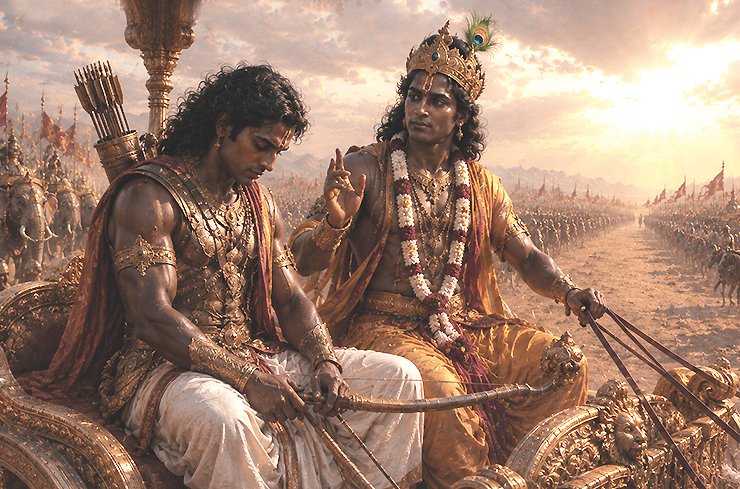
Krishna becomes friend, guide, and cousin to the Pandavas. The Pandavas are the five legendary warrior brothers at the heart of the Hindu epic, the Mahabharata . The Pandavas were living in disguise. Krishna attended Draupadi's svayamvara as a guest. Although the Pandavas were disguised, Krishna immediately recognized them as his cousins. Krishna was both their cousin and one of their closest friends, acting as their most trusted advisor, military strategist, and protector throughout their lives. This is the point at which Krishna's role shifts from the hero of the Yadavas to the trusted friend, counselor, and guide of the Pandavas-a relationship that culminates years later on the battlefield of Kurukshetra with the teaching of the Bhagavad Gita. Krishna worked tirelessly to prevent war through diplomacy. The Pandavas were the central human protagonists through whom many of the story's moral and spiritual lessons are expressed. Their lives culminate in the Kurukshetra War. ARJUNA WITH KRISHNA AS HIS CHARIOTEER
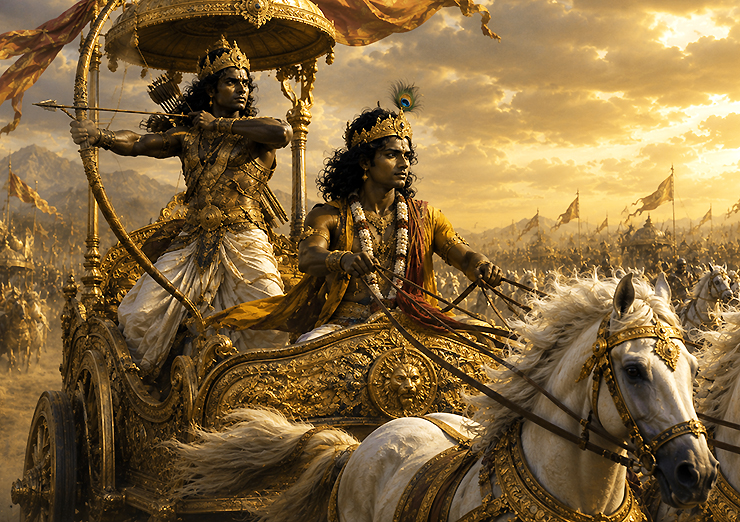
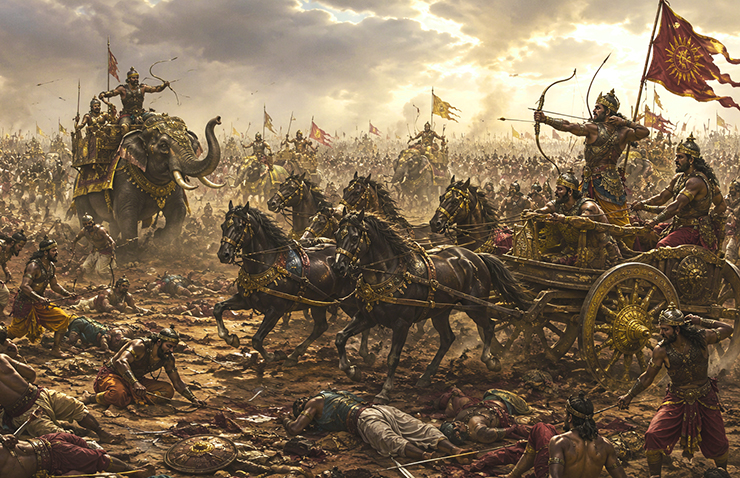
When peace fails, Lord Krishna served as the charioteer of Arjuna during the Kurukshetra War. Krishna – c. 2,000 BCE Central to the Mahabharata the great battle of Kurukshetra began over a bitter dispute between two royal families, the Pandavas and the Kauravas, over rightful rule of the kingdom. When all efforts at peace failed, including Krishna’s own attempt as a mediator, war became inevitable. Though he vowed not to fight, Krishna agreed to be the charioteer for Arjuna, the Pandava warrior, guiding him not only in battle but also in spirit. Bhagavad Gita
Krishna delivered the timeless teaching of the Bhagavad Gita on the battlefield of Kurukshetra, revealing the eternal truths of duty, righteousness, and the immortal soul. Arjuna is overcome with doubt at the thought of fighting his own relatives and teachers. Krishna, serving as his charioteer, reveals the eternal truths of life. He teaches that the soul is immortal, that one must perform one's duty without attachment to the results, and that love, selfless action, wisdom, and devotion all lead to union with God. --------------------------------------- "Live selflessly, perform your duty without attachment, see God in all beings, and surrender your heart to the Divine." "The soul is never born, nor does it ever die. It is unborn, eternal, everlasting, and ancient. It is not slain when the body is slain." "You have the right to action alone, but never to its fruits. Let not the fruits of action be your motive, nor let your attachment be to inaction." "Whenever righteousness declines and unrighteousness rises, then I manifest Myself. For the protection of the good, the destruction of evil, and the establishment of righteousness, I appear age after age." -------------------------------------- After hearing Krishna's immortal words of wisdom, Arjuna's doubts and despair are dispelled. Arjuna is now filled with renewed understanding. For centuries, India's sacred literature was preserved orally. Trained scholars memorized enormous texts with extraordinary precision. They developed sophisticated methods of recitation . Long before manuscripts were common, the Mahabharata and the Bhagavad Gita were transmitted from teacher to disciple entirely by memory. This discourse, preserved as the Bhagavad Gita ("The Song of the Lord"), one of the world's greatest spiritual classics, offering guidance on righteous living, inner peace, and the realization of the Divine. --------------------------------------- The Battle of Kurukshetra
The great war lasted eighteen days and drew millions of warriors from across India. Nearly every renowned warrior on both sides lost his life, and only a handful survived. The cost of the conflict was immense, with entire generations wiped out. After the victory at Kurukshetra, the Pandavas ruled wisely for many years under King Yudhishthira. In time, they renounced their kingdom and set out on their final pilgrimage toward the Himalayas in search of spiritual liberation. One by one the brothers fell along the journey, until only Yudhishthira remained, accompanied by a faithful dog who was ultimately revealed to symbolize Dharma - righteousness itself. The story of the Pandavas is therefore not merely one of winning a kingdom. It is the story of a lifelong quest to uphold righteousness, conquer the self, and ultimately attain spiritual liberation. The Pandavas Win. The Death of the Yadavas, The end of the war.Life in Dwarka Kingdom
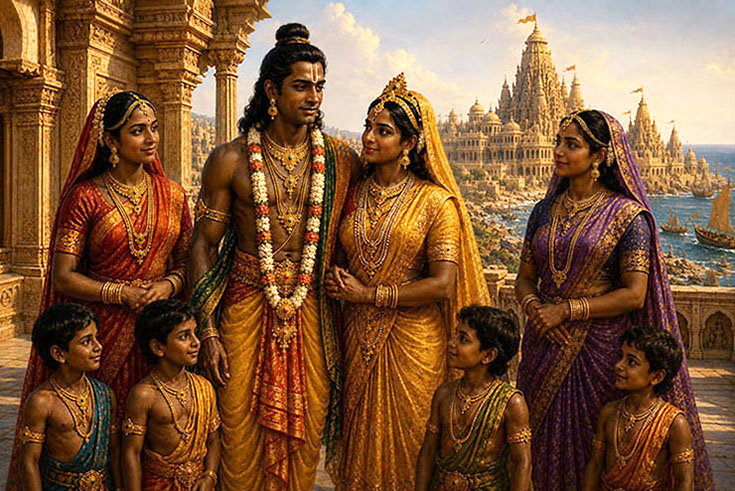
LORD KRISHNA, QUEEN RUKMINI AND FAMILY IN DWARKA Married life and childrenThough Krishna married many other women, Rukmini remained his chief consort and the queen of Dvaraka. When she longed for a child, Krishna flew to Mt. Kailash upon his mount Garuda and expressed his wife's desire to Shiva. Obliging, Shiva blessed Rukmini to be the bearer of the new incarnation of Kamadeva, whom he had previously immolated with his third eye. Many scriptures have mentioned that Rukmini and other wives of Krishna lived like sisters. Rukmini is traditionally considered to be the favourite and the primary wife of Krishna, Rukmini and Krishna had ten sons. Rukmini had a daughter named Charumati, his partiality towards her often provoking the ire of his second consort, of Satyabhama. Later traditions describe seven other principal queens, making eight chief wives (the Ashtabharya). The Puranas also describe Krishna rescuing 16,100 captive princesses and marrying them to restore their honor. He fathers many sons and daughters, including Pradyumna and Samba. The Death of the YadavasAbout 36 years later, Krishna's own clan, the Yadavas, became proud and quarrelsome. According to the Mahabharata, they fell into a drunken fight among themselves. They destroyed one another using reeds that had mysteriously become as hard as iron. Krishna did not prevent this, he knew his earthly mission was complete. End of the Dwarka Kingdom Krishna Leaves the WorldKrishna's Final Days
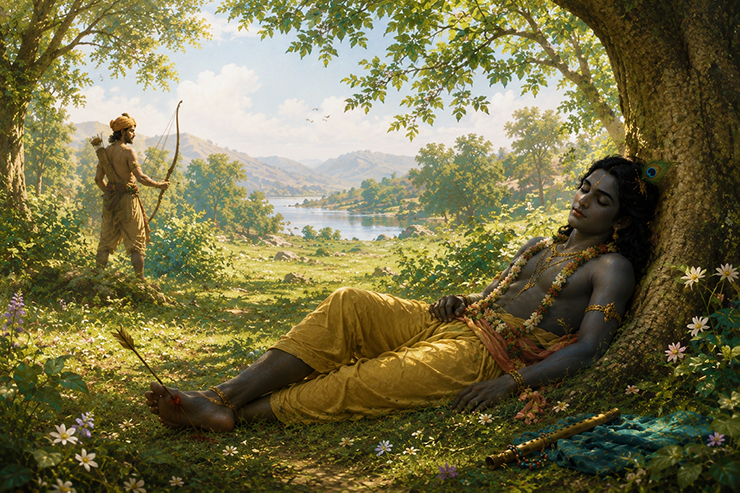
Final teachings, collectively known as the Uddhava Gita form a profound spiritual discourse. Knowing that the Yadava dynasty was about to face destruction, Krishna imparted his final wisdom to his close friend and devotee, Uddhava, to prepare him for the transition into the Kali Yuga. Krishna emphasizes that the physical world is temporary and constantly changing. He advises Uddhava to practice mental detachment from material possessions, relationships, and societal status to achieve lasting peace. Deeply moved and enlightened by these teachings, Uddhava wished to accompany Krishna during his departure from the earthly realm. However, Krishna gave him a final duty: to travel to the sacred region of Badarikashrama (Badrinath) in the Himalayas. There, Uddhava was tasked with living out his remaining days practicing these teachings and passing the divine knowledge down to future generations. Krishna shot by a hunters arrow. When a hunter, Jara, ran to claim his prey, he was horrified to find that he had shot Krishna. He fell to the ground, weeping and begging for punishment. Krishna comforted the terrified hunter, blessed him, and assured him that this was entirely destined to happen. Comforting Jara, Krishna explained that this was the karmic culmination of his past life as Lord Rama. Krishna then shed his mortal body and ascended to his divine abode.
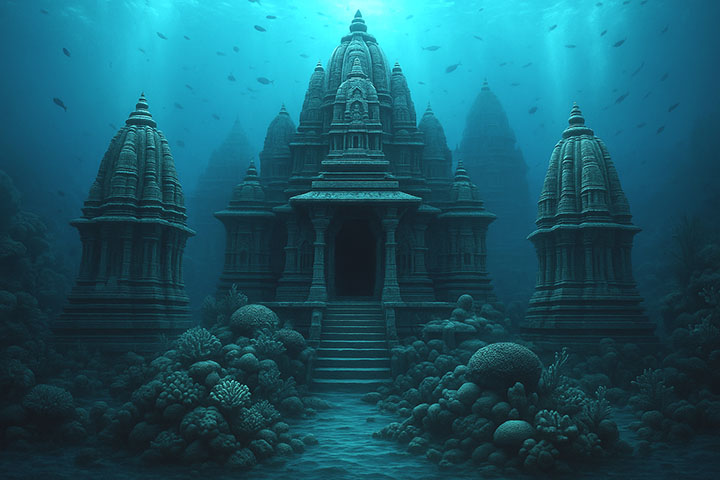
Krishna then departed from the world, marking the close of the Dvapara Yuga and the beginning of the Kali Yuga, the present age according to Hindu tradition. For many readers, the Bhagavad Gita is the spiritual heart of the Mahabharata because Krishna's teachings on the battlefield provide the philosophical foundation for everything that follows. The war illustrates those teachings in action, and Krishna's own departure reminds us that even the Avatar's earthly presence is temporary while the eternal truth he teaches remains. On the very same day that he departed the earth, the legendary city of Dwarka was submerged beneath the waters of the Arabian Sea. ---------------------------------------------------
Krishna, circa 2,000 BC. the central figure in the Mahabharata, is revered for his teachings in the Bhagavad Gita, where he imparts profound spiritual wisdom to the warrior Arjuna. His life encompasses divine playfulness, profound love, and the upholding of dharma. Krishna's kingdom in Dwarka is now believed to be submerged beneath the Arabian Sea, near the present city of Dwarka. Krishna in Dwarka PAGEThe western coastal city of Dwarka in present day Gujarat is said to be the site of Krishna’s later kingdom, a fabled city of golden towers and glittering palaces, now believed to lie submerged beneath the Arabian Sea. His departure from the earth marks the end of the Dvapara Yuga. KRISHNA MATHURA -------------------------------------- Krishnas' life in Dwarka KRISHNA in DWARKA Krishna Janmashtami: A two day festival celebrating the birth of Lord Krishna. In either August or September. HOW TO VISIT: Mathura is a short train ride away from Delhi. There are many hotels, both in Mathura and Vrindavan. There is a nice hotel near the train station in Mathura. Fancier hotels are in Vrindavan. You can drive from New Delhi (3 hour drive) to Vrindavan and Mathura. You will need a few days to see the main sites, including Gokul. Start your india pilgrimage: INDIA PILGRIMAGE If you choose to go to Dwarka in western Gujarat, the journey is complicated. A train from Jamnagar is the easiest way. Jamnagar is the closest airport to Dwarka. The original Dwarka of Krishna's reign is underwater. Some people visit it with scuba. There are a couple hotels in Orcha. There are many nice hotels in present Dwarka, by the sea. Closest to Dwarka, Veraval has direct plane flights from Mumbai. According to Puranic sources, Krishna's disappearance marks the end of Dvapara Yuga and the start of Kali Yuga. There is a small temple in Veraval, by the sea and rivermouth, where local people believe his body was fished out of the river and taken.
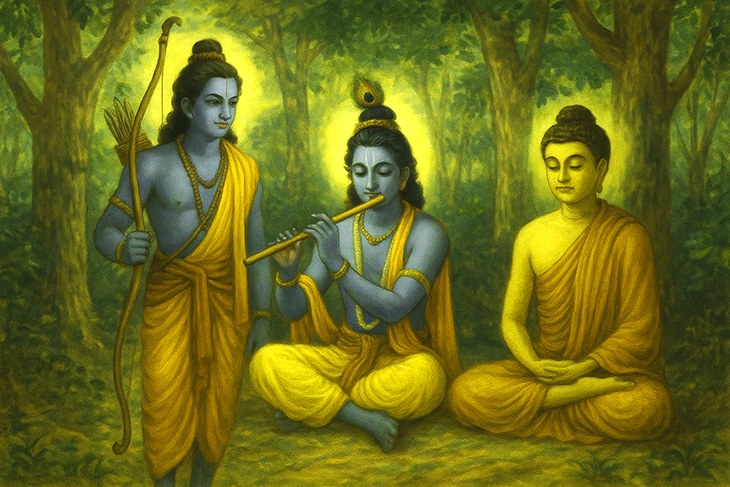
Ram Krishna Buddha. ----------------------------------------- The Light skinned Aryan pastoralists migrated from Central Asia into the Indian subcontinent around 1500 BCE, bringing with them early forms of the Indo-European languages. As they moved into northern India, particularly the Indus Valley and the Ganges Plain, the indigenous Dravidian populations gradually migrated southward. The Aryans established the foundations of the Vedic religion, a spiritual system based on the sacred hymns of the Rigveda, which later evolved into what is now known as Hinduism. ----------------------------------------------- Lord Buddha Lord Buddha page ----------------------------------------------- Lord Rama Lord Rama page Start you India Pilgrmage: INDIA PILGRIMAGE Return to Avatars page AVATAR IN INDIA ----------------------------------------------- MEHER BABA'S SAMADHI TOMB. SAMADHI VISIT
ANN LOVELL ART MEHER BABA'S SAMADHI TOMB . SAMADHI VISIT ------------------------------------------- Story of Meher Baba STORY MEHER BABA ---------------------------------------
|


 Kurukshetra War