Avatar Rama in India
|
Rama and Sita in India
"Selfless service and love are twin divine qualities. Only the one who loves can serve. Serve your beloved God and you are serving your own Self in every other self." Lord Meher page 1855 Video: Jim Meyers: 'Names of Love" NAMES OF LOVE When the Aryans migrated into India (1,500 BCE), they encountered love and devotion of Rama and Krishna. Rather than ignoring this, they gradually absorbed and refined the beliefs. The Aryans brought a structured spiritual language, the Vedic idea of cosmic law. The blending of indigenous devotion with Aryan philosophy shaped the beginnings of Hinduism, accepting Rama and Krishna as manifestations of God. -------------------------------------- Lord Ram story 3,500 BCE
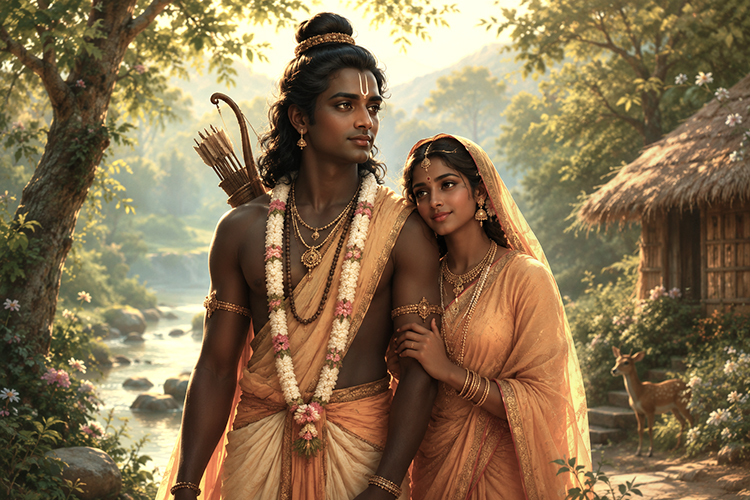
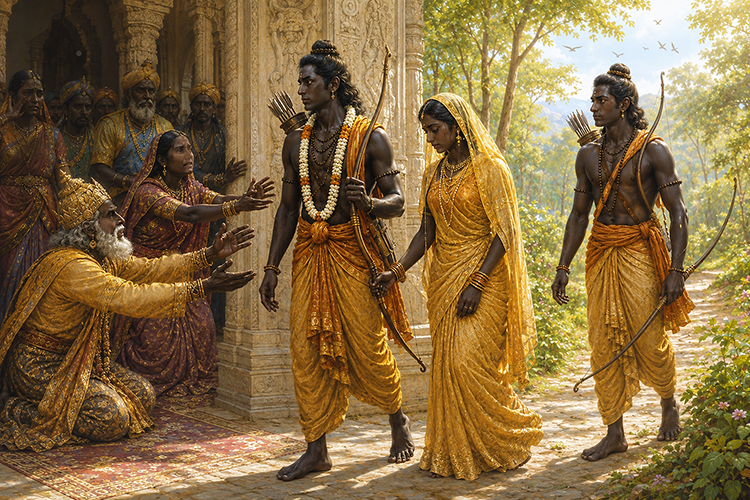
Exiled to the forest for 14 years. Prince Rama was chosen to become the next king of Ayodhya, Queen Kaikeyi reminded King Dasharatha of two promises. She demanded that her own son, Bharata, be crowned king instead, and that Rama be sent into exile in the forest for fourteen years. Although Rama urged Sita to remain, she refused to be separated from her husband, insisting that her home was wherever he was. Rama's devoted younger brother Lakshmana also chose to accompany them, they lived the life of wandering ascetics. Rama, the noble prince of Ayodhya and eldest son of King Dasharatha, is venerated throughout India and beyond as the very embodiment of dharma - righteousness, duty, and moral integrity. Born into royalty, Rama’s greatness lay in the quiet strength of his character, his devotion to truth, and his unwavering commitment to the path of virtue, even in the face of immense personal sacrifice. The story of Rama and Sita.
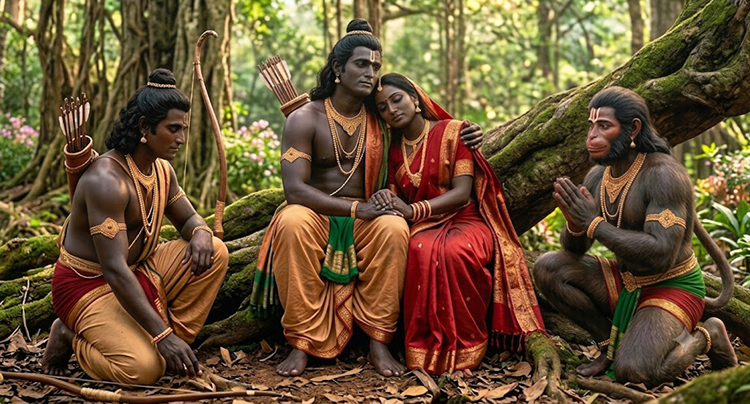
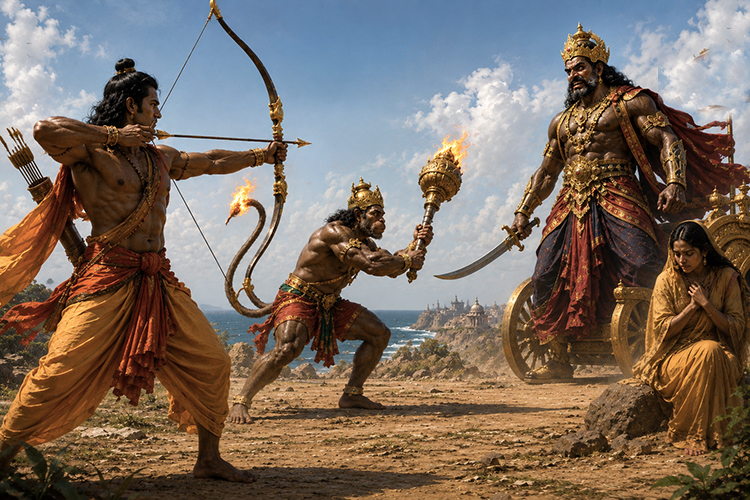
Rama Sita exile The timeless epic of the Ramayana recounts his extraordinary journey: his unjust exile into the forest, accompanied only by his devoted wife Sita and loyal brother Lakshmana. "In the forested area of Chitrakot; Ram, Laxman and Sita spent eleven years of their fourteen-year exile. The once thick forest or jungle area is famous for being a hidden abode of saints." Happy Valley, situated fourteen miles to the north of Ahmednagar. Once a forest area, legend has it that during Lord Ram's wanderings in exile, he, Sita and Laxman had stayed at Happy Valley for some time. "The legend says that Sita was either thirsty or wanted to bathe but there was no water nearby, so Ram shot an arrow into the rocks and a stream of water began to pour out." Later, in the forest of Nasik, the tragic abduction of Sita by the demon king Ravana of Lanka. Rama searches for Sita and later forms alliance with the monkey god Hanuman, whose boundless devotion becomes legendary. Together, with an army of vanaras (monkey warriors), Rama wages a righteous war against the forces of darkness. quotes: Lord Meher online.
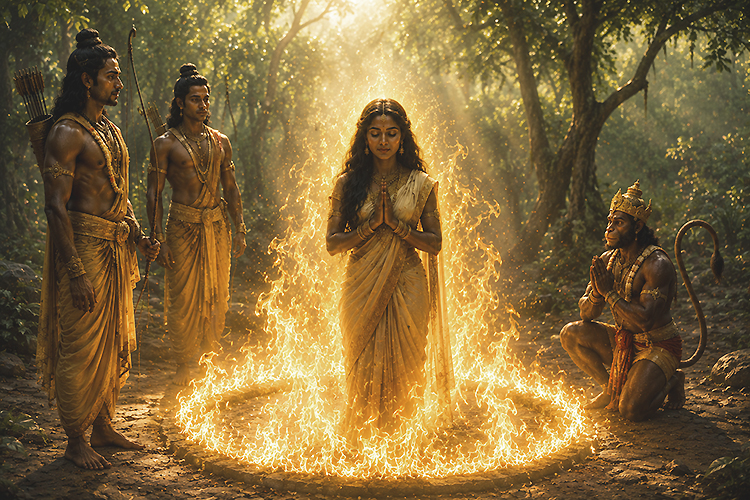
Rama kills Ravana saves Sita After Rama rescues Sita from Ravana, she proves her purity by undergoing the ordeal of fire (Agni Pariksha). The fire god returns her unharmed, demonstrating that she has remained completely faithful. The trial was a divine proof of Sita's purity. Fire, regarded as the ultimate purifier, could not harm one who was innocent.
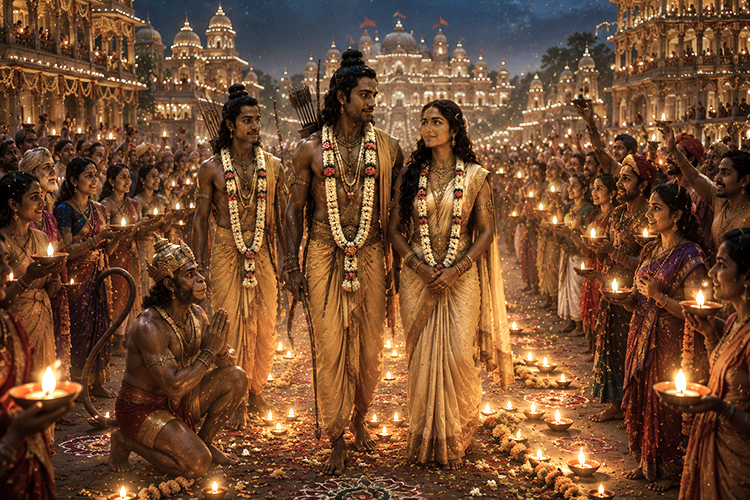
RAM SITA EXILE STORY page: RAM SITA EXILE His victorious return to Ayodhya after fourteen years of exile, bringing Sita safely home marks the spiritual and symbolic return of light after darkness, justice after injustice. This divine homecoming is celebrated each year during Diwali, the Festival of Lights, when lamps are lit across India to honor the triumph of good over evil and the power of love, faith, and duty. DIVALI FESTIVAL: 'LIGHT WINS OVER DARKNESS'
DIVALI FESTIVAL: 'POWER OF LOVE FAITH AND DUTY' Soon afterward, Rama was crowned king. Sita became queen, and Rama's reign—known as Rama Rajya—was celebrated as an ideal kingdom where justice, prosperity, and righteousness prevailed.For some time, the kingdom flourished. In the Hindu ideal of kingship, a king's foremost duty was to protect not only the kingdom but also the confidence and trust of the people. The people were happy. Rama acted not as a husband but as an ideal king (raja dharma), placing his public responsibilities above his personal feelings. Some time after the coronation, Sita became pregnant with Rama's children. In the Valmiki Ramayana, Rama himself never expresses doubt about Sita's faithfulness. He knows she is innocent. His conflict is between his love for Sita and what he believes is his duty as king to remain beyond public reproach. People began to question that he would accept a wife who had lived in another man's house, even though she was innocent.
Rama, believing that a king must place the confidence of his people above his own happiness, reluctantly sends the pregnant Sita away to the forest. Although Sita passed the Agni Pariksha, the story does not end there. Unable to send her away himself, Rama instructed Lakshmana to escort the pregnant Sita into the forest under the pretense of fulfilling her wish to visit the hermitages. When they reached the forest near the hermitage of the sage Valmiki, Lakshmana tearfully revealed the truth. Heartbroken, Sita accepted her fate, she understood the burden of his role, though she suffered deeply from the separation. Lakshmana returned to Ayodhya in sorrow.
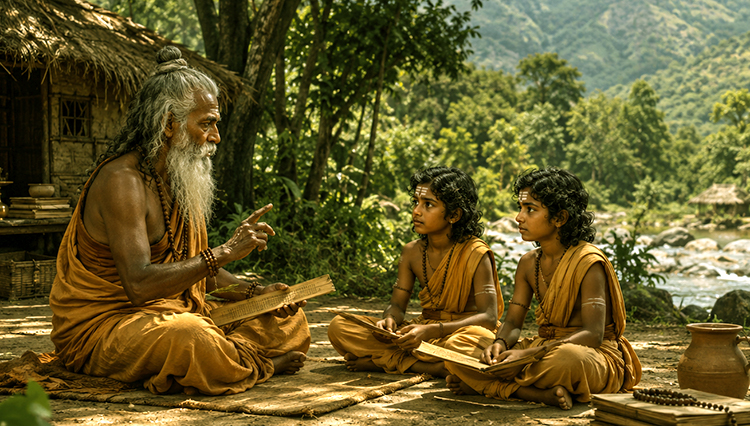
There she finds refuge in the hermitage of Valmiki, where she gives birth to twin sons, Lava and Kusha. an idyllic woodland retreat where Sage Valmiki, his disciples, Sita, and her sons Lava and Kusha resided. The two boys grow up under Valmiki's care and eventually recite the Ramayana before Rama himself. When Rama realizes they are his sons, Sita is brought before the royal assembly. Valmiki publicly declares that she is completely pure. Yet another public affirmation is requested. "Ram denounced his beloved wife, Sita, even though she was pure in heart and mind and proved herself so, after her return from Sri Lanka. Thus Ram bowed to his subjects' opinions and thereby kept his throne. This he should not have done.".. Lord Meher Online page: 4943. At this point Sita decides she will no longer submit to repeated tests of her virtue. She invokes her true mother, the Earth: "If I have never thought of anyone but Rama in mind, word, or deed, then, O Mother Earth, receive me."
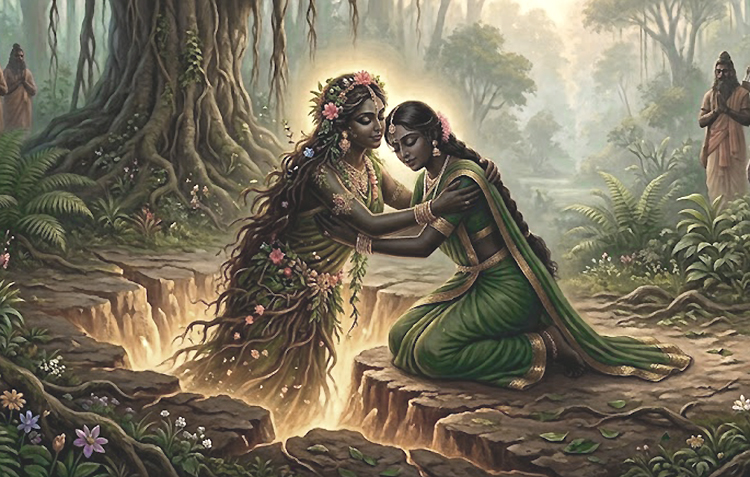
The Earth immediately responds. The ground opens, the Earth goddess rises, embraces Sita, and takes her back into the earth. Sita disappears forever from the human world. Her return to the Earth symbolized the completion of her earthly mission and a return to her divine origin. Sita's return to Mother Earth is not viewed as a defeat, but as conclusion of her divine role in Rama's advent. Rama is an eternal symbol of duty and sacrifice. And Sita, in her strength and unyielding truth, remains one of the most revered and radiant heroines of all time. The Adhyatma Ramayana - a spiritual retelling of the Ramayana and theological treatise considered foundational by Ramanandi monasteries And the Ramcharitmanas - a popular devotional retelling of the Ramayana . inspires thousands of Ramilla festival performances during autumn every year in India. RAM SITA EXILE page: RAM SITA EXILE ------------------------------------------- Ayodhya is easily accessible from Lucknow or is about a 4+hour drive from Varanasi and Sarnath. The newly constructed Ram Janmabhoomi temple is the major attraction, along with many other historic and vibrant temples. Evening arti by the riverside is a moving experience.The archaeological evidence confirms that an ancient city existed at Ayodhya during the early historic period. Many fine hotels are available in Ayodhya and the nearby town of Faizabad. Be aware that most temples close for midday rest between 11 AM and 2 PM. This is a good time to enjoy lunch, take a boat ride, or explore the local bazaars. Don’t miss the new Janmabhoomi Temple, honoring the birthplace of Rama. To continue your pilgrimage, drive to Lucknow. From there, direct flights are available to Delhi or Srinagar. RAM SITA EXILE page: RAM SITA EXILE INDIA PILGRIMAGE PAGE INDIA PILGRIMAGE ------------------------------------------------- ------------------------------------------------- The winter months, particularly December and January, showcase Ayodhya, Varanasi and Sarnath at their best, with clear skies and a pleasant breeze. The winter season in Ayodhya witnesses the celebration of Diwali, a festival of lights. Monsoon, from July to September, the River Ganges in Varanasi and the Sarayu River in Ayodhya can become unnavigable. --------------------------------------------- Lord Krishna Story Page LORD KRISHNA Start your india pilgrimage: INDIA PILGRIMAGE Lord Buddha Story Page LORD BUDDHA -------------------------------------------- Lord Jesus in Kashmir Page LORD BUDDHA -------------------------------------------- Avatar Meher Baba Story STORY MEHER BABA . -------------------------------------------- MEHER BABA'S SAMADHI TOMB . SAMADHI VISIT
ANN LOVELL ART MEHER BABA'S SAMADHI TOMB . SAMADHI VISIT ------------------------------------------- Meher Baba dictated two books: 'God Speaks' and 'The Discourses'. Avatar Meher Baba Trust https://avatarmeherbabatrust.org .
|
||||||||||
https://avatarmeherbabatrust.org . AVATAR MEHER BABA TRUST WEBSITE Elenas' Suggested Samadhi Superstructure Samadhi Superstructure.. Elenas India stories page: PERSONAL STORIES |

Avatar Meher Baba