MEHER BABA INDIA TRAVELS
 |
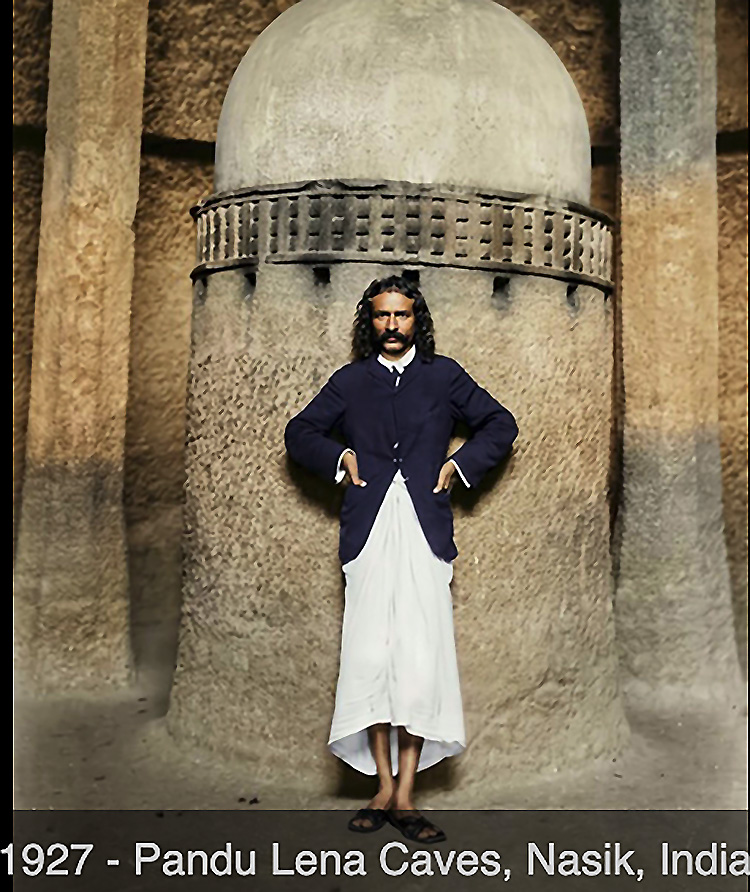
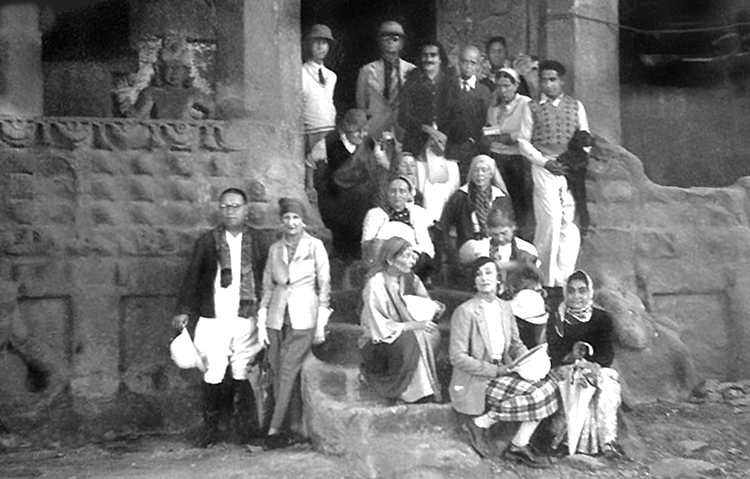
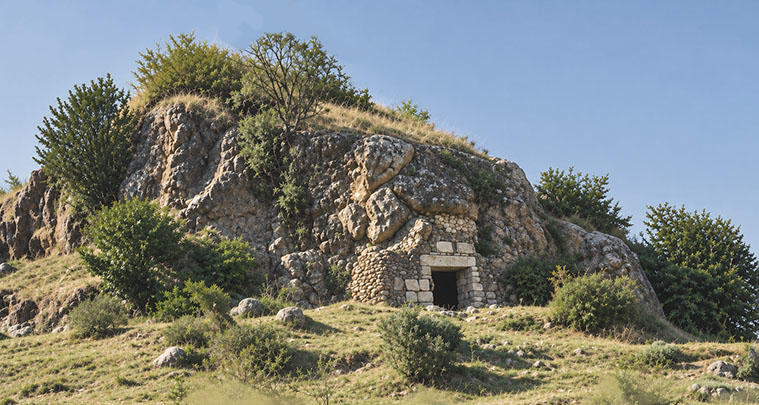
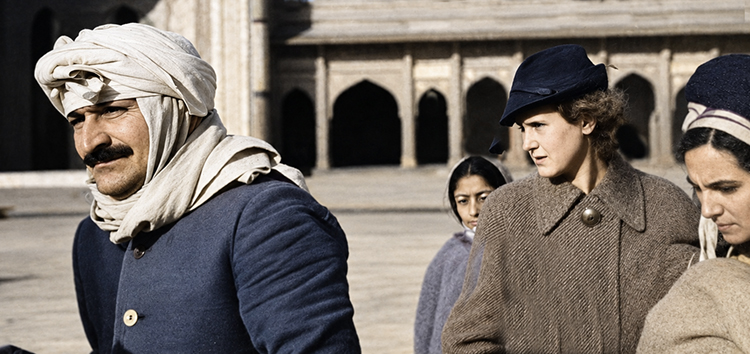
Highlights of Meher Baba's Travels in IndiaMeher Baba traveled extensively throughout India, accompanied by His mandali. His journeys were connected with periods of seclusion, work with spiritually advanced souls known as masts, visits to holy places, and darshans with large numbers of His followers. video: Western disciples Travel with Baba: I am the one reality Nasik - 1920s–1930s Nasik was an important early center for Baba and the mandali. Merwan spent critical time at Bhorgad Mountain cave. The cave sits on a hill that is actually an acient 1,500 year old hill fortress located about 15 kilometers north of Nasik. In 1920, Merwan fasted there for 40 days. The area includes simple rock-cut cavities, a small temple, and views of nearby peaks. It was during this period in Nasik that his early disciples first gave him the name "Meher Baba".
Baba made multiple journeys to Nasik. In 1929, Meher Baba shifted the women mandali from Meherabad to Nashik to provide a change of environment while he underwent intense periods of travel, fasting, and seclusion, he traveled back and forth between Meherabad and Nasik. In 1936 Baba purchased a Nasik property. It was situated amidst beautiful surroundings with splendid scenery. The Western men and women were brought to stay there. He spent considerable periods there, sometimes in seclusion. Nasik became where Baba and the mandali lived and worked for extended periods. The western group arrived and the official and formal opening of their stay took place December 1936 . The Nasik property was given up and Baba ordered the facility to be shut down permanently in August 1937 when the group of disciples left India for France. Nasik group to France - 1937
Khuldabad- 1927 –1950sThe “Valley of the Saints,” Meher Baba visited Khuldabad several times, beginning in 1927. Baba sat in seclusion in the cave of the Sufi Qutub Zarzari Zar Baksh (Sai Baba's Master in one of Sai's previous incarnations), and also contacted a mast near the shrine. Baba then proceeded to Daulatabad, and there too sat in several shrines for a fixed time before returning to Khuldabad. Baba again returned November 1951. Baba spent time in seclusion at the shrines and performed acts of profound humility among both Muslim and Hindu families. It was in 1951 that Baba dictated his Prayer of Repentance.
website: The Abode of the Saints khuldabad-the-abode-of-saints/ Itarsi - 1924After landing back in Karachi, via ship from Persia, Baba and the mandali headed inland. They covered thousands of miles across British India using the extensive railway network. The group traveled through Hyderabad and across the desert landscapes of Rajasthan, stopping in Jaipur then continuing into Lucknow and as far as Raxaul, located on the border of Nepal. From the northern borders they turned south through central India up to Itarsi. Itarsi ranks among the busiest railway junctions in India, serving as a vital link for long-distance passenger and freight movement. It serves as a major commercial hub for agricultural goods, warehousing projects, and agro-based industries. Itarsi was the scene of one of the most unusual episodes of Baba's early travels. After arriving by train, Baba left the men who had been traveling with Him and spent about a week alone, wandering through the town and surrounding countryside. Meher Baba wandered alone near the Itarsi railway platform during a journey in his early ministry. The only recorded time during Meher Baba's adulthood that he traveled alone without any of the mandali with him. Video of Itarsi now: https://www.youtube.com/watch?v=mgSTRWkZZFU
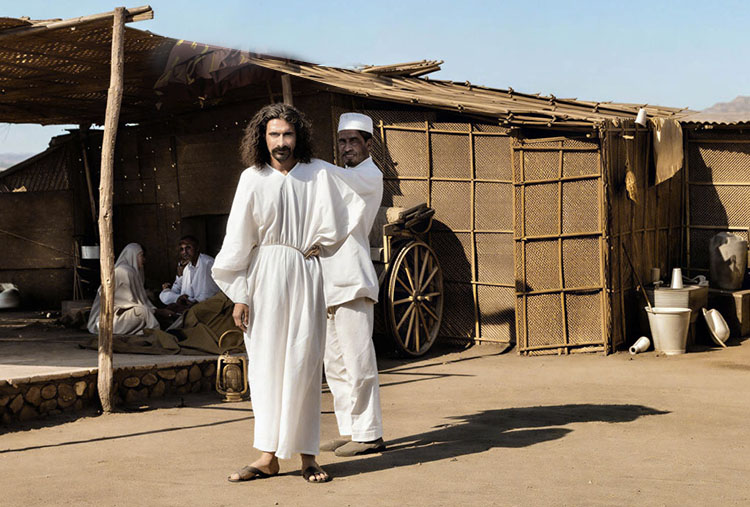
Dakshineshwar The second North India Trip began August 1924 and was a deeply intense journey focused on seeking out sadhus. Traveling with a drastically reduced group of only three mandali members.. They visited Dakshineshwar , the home village of the famous Perfect Master Sri Ramakrishna Paramahansa. This became a landmark Baba returned to frequently throughout his life. Unlike earlier journeys, the second trip was marked by significant physical and emotional strain for the close disciples: Accounts note that by the end of August in Baroda, Baba exhibited heavily distressed states. This deeply shook the remaining mandali. Website: The main Sri Ramakrishna Temple features a design that deliberately blends Hindu, Christian, Islamic, and Buddhist architectural motifs to symbolize the harmony and unity of all religions. Harvan, Srinagar 1929 Two small cottages were rented below the Harvan hill, one for the mandali and one for the boys. A hut for Baba seclusion was erected 500 feet up the side of the hill. Baba was to remain in the hut and two of the mandali were to stay next to it. 1933 Baba returned to Harvan with the Western women. He pointed out to them where Jesus had been buried. SRINAGAR JESUS
Panchgani - 1930s
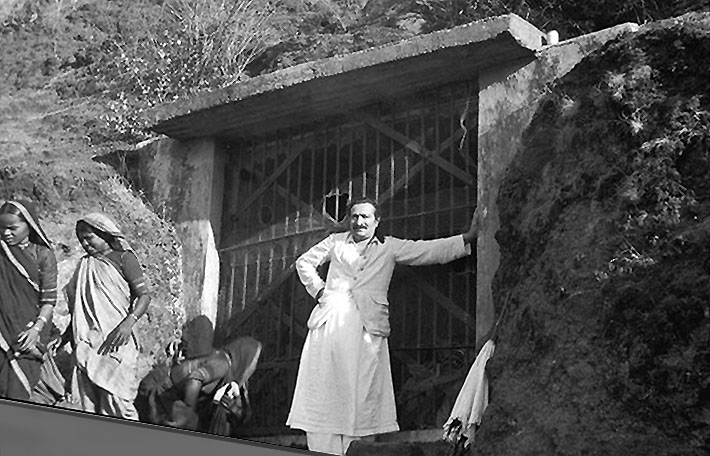
MSI collection photo. Tiger Valley cave. Panchgani became an important mountain retreat for Baba and the mandali. 1930. His first and highly significant stay. A special cave was excavated into the cliffside for him overlooking Tiger Valley .Baba stayed in complete seclusion and fasted for two weeks while a dozen mandali camped nearby. He returned 1935 to work intensively in the Tiger Valley cave. . In 1938 Baba shifted his entire ashram from Upper Meherabad to Panchgani to escape the intense summer heat for 3 months. During this major stay, a group of 24 Eastern and Western disciples lived and worked under his strict direction. The Western women, who were unaccustomed to intense manual labor, had to work side-by-side with the Eastern mandali cleaning cages, scrubbing down animals, and managing the constant mess of the pets. The Panchgani stay is considered a success because it successfully unified his Eastern and Western women disciples into a single, cohesive spiritual family.
Mahabaleshwar - 1940s–1950sMahabaleshwar became an important mountain retreat for Baba and the mandali. In October 1950, Meher Baba and his disciples moved to Mahabaleshwar and rented the Aga Khan Bungalo. In mid-October. He spent periods there in seclusion, including a remarkable 100 day period of seclusion in 1947 in a small hut on the estate. They stayed in places like the Pasarni Bungalo. The Aga Khan's Palace is a very large estate with a spacious compound and stables where Baba established a mast ashram and utilized smaller auxiliary quarters. The Rippon Hotel was also used by Baba during trips. Later stays at Florence Hall Baba and the women mandali lived strictly inside the main house. Baba visited and stayed in Mahabaleshwar during multiple periods. Western women mandali, such as Irene Billo , Margaret Craske, and Rano Gayley, also stayed with the eastern women during these hill station trips. The men mandali were required to stay completely separate in outside servant quarters to maintain the women's seclusion.In later years He continued to return to Mahabaleshwar with the mandali. To pass the time in the hills while Baba was away on mast work, horses were sometimes purchased for the women mandali, including Mehera, Mani, Irene, and Katie to ride around the properties. The women mandali also looked after Baba's favorite animals that traveled with them. For example, a thoroughbred filly named Sheba was cared for directly by Mehera and the other women. The women went on an excursion to Venna Lake and rowed little boats. (The lake was constructed in 1842 by Shri Appasaheb Maharaj, the Raja of Satara and a descendant of Shivaji Maharaj. ----------------------------------- Meher Baba visited the Narmada River in India .
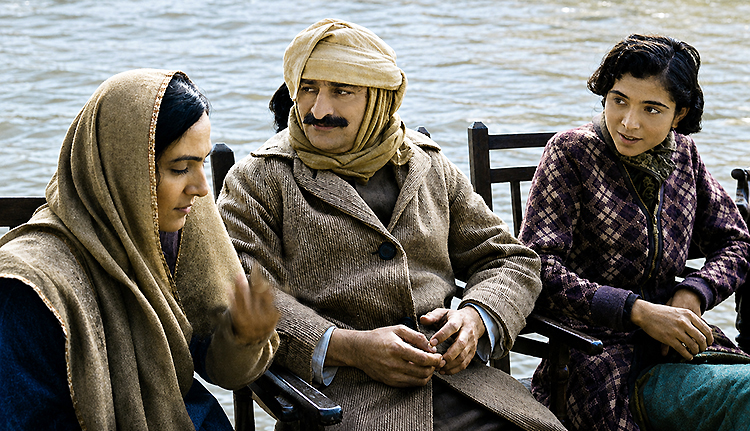
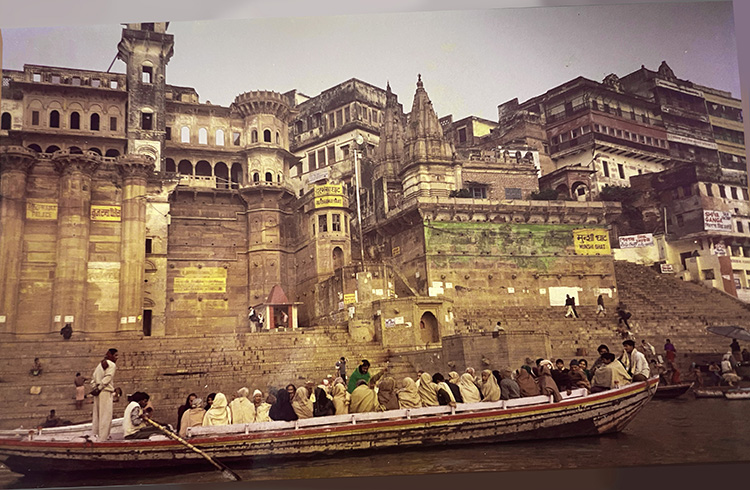
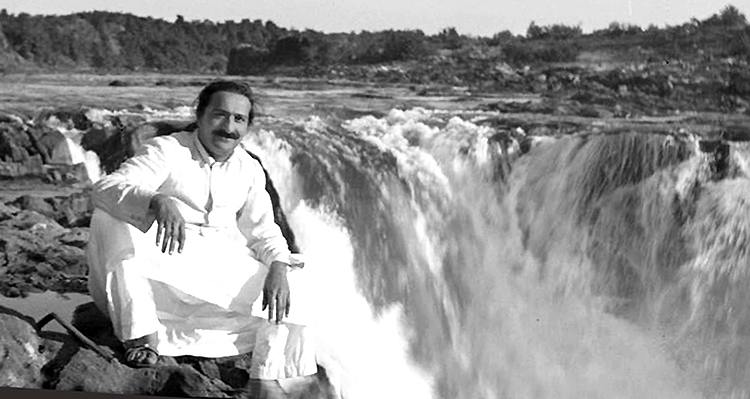
Christmas Day, December 25, 1938. Near Jabalpur and Mandla, specifically at the Marble Rocks (Bhedaghat) and Sahasra-dhara on the Narmada River. Meher Baba and his group took a boat ride on the river. He dipped his hands into the water, an action noted by close ones as a rare and significant moment of sanctifying the living water. Benares 1939 During their visit to Benares (Varanasi) in January 1939 because this was a rapid traveling tour utilizing the custom-built, heavily overloaded "Blue Bus", the group stayed in a temporary camping setup on the outskirts of the city, utilizing the Blue Bus and accompanying transport for shelter while the men mandali managed camp logistics.It provided the isolation for the large group of 24 women, men companions, and pets traveling in the custom built Blue Bus. Baba took the Western and Eastern women mandali on a boat ride across the Ganges River and visited masts in the area.
Benares (Varanasi) - 1949During the New Life, Baba came to Benares with His companions and lived under the severe conditions of the New Life, depending on God for everything. Baba and the companions went out begging for food and lived without money or possessions. After about two weeks. The begging-training at Benares will be introduced by my going out with some companions to beg at at ten o'clock each morning. Khare's family should be ready at Nath's place on the 25th, as I cannot go as far as the university, where the latter stays. November the companions are to go out begging in pairs. How to beg and what to say will be explained. For personal shopping in the bazaar, from tomorrow, you can go out from noon to 5:00 P.M. As permitted, the companions in groups of four went sightseeing to the ghats along the Ganges River. Baba led the group on foot toward Sarnath. Sarnath - 1949Baba and the New Life companions stayed in Sarnath during the beginning of the walking phase of the New Life. Sarnath was the real place of Buddha. The men and women were together as a wandering group, living with very few possessions. Baba also led the men into the ancient ruins, where they undertook a remarkable period of prayer in the place associated with Buddha Hardwar - 1920s–1940sBaba visited Hardwar on several journeys with members of the mandali. He visited the holy places along the Ganges and met spiritual seekers and masts. During the extensive mast work of the early 1940s, Hardwar was among the northern Indian places where Baba sought out spiritually advanced souls.
Rishikesh - 1920s–1940sMeher Baba and his mandali first visited Rishikesh in 1924 during his wide ranging tour of northern and central India with members of the mandali, they hired a car from Haridwar to travel the roughly 14 miles to Rishikesh. Baba contacted local ascetics, masts, and lepers, bowing down to them and meeting figures such as Nepali Baba. They went on to Lakshman Jhula, where He again met ascetics. In 1942 He returned with both the men and women mandali and remained there for about a month. The group lived simply while Baba continued His spiritual work. Baba and his Eastern and Western mandali stayed in a bungalow situated on a cliffside overlooking the Ganges River in a forested area known as Swarga Ashram. The villa was situated directly in the middle of a region heavily populated by the small thatched huts of practicing sadhus, ascetics, and monks. The women were permitted to wash their cloths and sit right on the edge of the river bank on the property. Baba instructed them to sit quitely and repeat his name for 30 minuts every evening. Ajmer - 1939–1941Meher Baba visited the revered Khwaja Garib Nawaz Dargah Sharif multiple times throughout his life. Because Khwaja Moinuddin Chishti is recognized as one of the great Sufi Perfect Masters (Qutubs), Baba treated this shrine with reverence, including during his 1939 Blue Bus Tour and later phases of his travels. During His visits to Ajmer, Baba contacted spiritually advanced souls. He also visited the sacred hill of Taragarh. Baba visited other places in and around Ajmer with the women mandali, including Ana Sagar Lake, Pushkar Lake, the Hindu temple of Lakshmi, and a Jain temple. During both His 1939 and 1941 visits, private residential bungalows were rented in Ajmer. These accommodations were arranged to provide separate quarters for the men and women mandali and to allow Baba to bring in and work with masts in complete seclusion.
While traveling by road during the famous 1939 Blue Bus Tour, the group stopped and stayed at a government-run travelers' rest house on their approach to Ajmer. Mt. Abu - 1949While Baba and a few of the men mandali left the base frequently for strenuous, fast-paced "mast tours" across the region. The close women mandali remained at the Mount Abu headquarters. The temporary ashram, during the spring of 1949 was strictly secluded and highly disciplined base camp. The women mandali lived under absolute seclusion (parda). They did not leave the bungalow or have contact with outsiders. When Baba and his close assistants went out on essential errands or on fast-paced travels throughout the region, the women would simply provide them with strict shopping lists for food and other supplies. The ashram served as the central base from which Baba undertook his intense and final “mast tours” across India. It closed permanently in May 1949, when Baba and the entire group left Mount Abu and returned to Meherazad. It was from this Mount Abu ashram that Baba composed his complete renunciation of all property, money, and personal ties as he prepared to enter the New Life. "New Life Journey" lasted from October 1949 to February, 1952. Meher Baba left behind his possessions, properties, and regular connections to live a life of total reliance on God. He set aside his role as a Perfect Master to live as a common man and a "Perfect Seeker," traveling extensively across India, mostly on foot with a small group of close companions. The phase culminated in early 1952 with a Manonash (seclusion ) bringing the active New Life journey to a close in Dehra dun, February 1952. New Life Page: BABA'S 'NEW LIFE' Dehradun - 1940s–1950s
Dehradun became one of Baba's most important northern bases. He stayed there for extended periods with members of the mandali, carried out extensive mast work, and spent periods in seclusion. Both men and women accompanied Him there, while in later years, Dehradun became an important center during the New Life and the period of His Fiery Free Life. God Speaks Using his alphabet board, Meher Baba began dictating his most significant and comprehensive book . He completed the dictation during his stay in the city.
1953 in Dehradun, Meher Baba issued one of his most powerful and explicit spiritual discourses, known as "The Highest of the High" he unequivocally affirmed his identity as the Avatar of the Age and outlined the nature of his manifestation.
Meher Baba composed and gave "The Master's Prayer" (also known as the Parvardigar Prayer to his disciples. He instructed them to recite it daily. Blue Bus Tours (December 1938 – November 1941) Meher Baba, along with His Eastern and Western women disciples, traversed thousands of miles across the Indian subcontinent. The Blue Bus was a custom made vehicle designed to transport Meher Baba and His disciples through diverse terrains and brutal travel conditions. Originally built to seat only 16 passengers comfortably. The bus regiularly packed in 20 to 24 women, children, luggage and even pets. Video: Blue Bus Tours. Talk The Blue Bus Tours Bangalore - 1939–1940Baba visited Bangalore with the mandali during His travels in southern India. He visited briefly in 1930 and again in 1934. His major extended stay occurred when he temporarily shifted his headquarters there in 1939, renting a house called "The Links" on Sankey Road to establish a local ashram. January 1940, his focus shifted heavily toward an intense phase of tracking and working with masts . During this period, Baba also laid the foundation for a spiritual center in nearby Byramangala, Baba officially inaugurated the center. Baba planned an expansive, all-embracing universal ashram spanning over 560 acres, After nine small buildings were constructed, his focus shifted away from the site . He relocated his headquarters back north in 1940, Meher Baba returned to Byramangala for a brief three day stay in 1953, residing in one of the completed rooms. After several decades of relative inactivity, a group of Meher Baba's followers formed a dedicated trust to revive the site in 1983. Today, the Meher Baba Universal Spiritual Centre operates as an active, serene pilgrimage site.
Hyderabad - 1940s–1950sMeher Baba stayed in Hyderabad October 1951 , to perform spiritual work known as Manonash (the annihilation of the mind) during his New Life period. Meher Baba stayed in a small cave on a hill near Khojaguda, Hyderabad. He instructed his close disciples and followers to offer prayers at the same time across different religious sites in India, he ended his seclusion in the cave, declaring his work there 100% successful. Manonash translates to the 'anihelation of the mind'. Meher Baba described it as the final, most intense phase of his "New Life" period, where he sought to completely dissolve the limited human mind so that only the divine, unlimited mind remains.
Manonash is not just stopping thoughts, but destroying the mind's ability to be bound by desires, fears, and illusions.
Hyderabad became an important place during Baba's later travels in southern India. He returned there on several occasions, meeting followers and carrying out His work with spiritually advanced souls. The city was also connected with the extensive darshan journeys of the 1950s. Video: Meheru Remembers Travel with Baba: "Travel with Meher Baba" "Avatar Meher Baba Ki Jai!" Meher Baba in Hamirpur District 1952 -1954Meher Baba made two visits to Hamirpur District, in 1952 and again in 1954. He traveled with members of His men mandali, while the women remained at Mahabaleshwar. Local lovers worked to arrange His program and to prepare places where He could stay. During His first visit in 1952, Baba gave darshan to thousands of people throughout Hamirpur District. He visited villages, met His followers and workers, and continued from one place to another wherever arrangements had been made for the people to see Him. Baba gave darshan at Hamirpur, Ingohta, Sumerpur, Meherastana–Mahewa, Mahoba, Maudaha, Kulpahar, Panwari, Rath, Nauranga, Jarakhar, Dhagwan, Amarpura and Dhanouri. The journey was not easy. Baba and those accompanying Him traveled through largely rural areas where roads and bridges were often primitive. Despite the difficult conditions, Baba continued from village to village, meeting the people wherever they had gathered. Baba returned to Hamirpur District for a second visit in 1954. He visited schools, villages and homes and attended public gatherings. He spoke with students and workers, gave prasad, met individual families, and spent time with the many people who came to see Him. Ichhuara and the Betwa RiverTo continue farther into the interior, they had to cross the Betwa River by ferry and then continue their journey by bullock cart. The people of Ichhuara had prepared with great love for Baba’s arrival. While crossing the Betwa River, Baba dipped His hands and toes into the water. That evening, He walked alone for some time into a nearby part of the forest. Early the following morning Baba bathed in waters from the Betwa River. . He also drank of the river water. Lord Meher online p,3433 Andhra - 1954Following the Hamirpur journey, Baba continued to Andhra with members of the mandali. He made two major tours of Andhra Pradesh, lasting roughly two to three weeks each. During these journeys, he rarely stayed in one place, moving rapidly between towns, staying in dak bungalows, schools and private homes of disciples. 1953 He then traveled throughout the West Godavari district, passing through and staying near towns. Second Andhra Tour in 1954. Meher Baba publicly declared his Avatarhood for the first time. It was here, inside Dr. Rao’s home , that Meher Baba celebrated his 60th birthday on February 25, 1954, at exactly 5:00 AM. He moved sequentially along the Godavari River, holding massive mass darshans during the day and resting at localized camps or rest houses.
Satara - 1947 - 1958A small town where Meher Baba lived and worked during various phases. He rented houses here for long stretches spanning several weeks and months, returning to it on multiple separate occasions for concentrated inner work. Meher Baba established an ashram in Satara specifically to work with masts ( Chacha was God-realized, a seventh-plane majzoob). To maintain strict privacy and spiritual seclusion, Meher Baba kept the men and women disciples in entirely separate houses. Mehera lived with Baba and the women mandali at Grafton Bungalow while the men lived nearby at Rosewood Cottage. During the 1947 phase in Satara, Mehera and the women disciples managed the household. During the long 1953 –1958 stays, Mehera remained by Baba's side here. After traveling and recuperating from a major 1952 automobile accident in the United States, Baba shifted his primary residential base to Satara for nearly three years. This was an era of intense internal activity, fasts, and dictating key spiritual treatises. Babas' second major car accident, outside Satara in December 1956. The stretch of road near Udtara was completely empty of traffic. Around 5 PM, the car suddenly and inexplicably went completely out of control. It dashed against a stone culvert and crashed into a ditch. When Eruch vision gradually dissipated, he saw Baba sitting silently with blood covering His face (especially the right side) and a look of stunning triumph on His face. Baba pointed to His face and right pelvis, indicating it was very painful. By this time Eruch had come to. He had multiple rib fractures. He came over to Baba’s side of the car, despite his own agony, and helped Vishnu lift Baba out of the car and lay Him on the road. He was so focused he didn’t feel his rib fractures. A car was passing at this moment which they hailed and told the driver they had had an accident and would he carry them to Satara? He agreed and they got Baba and Vishnu into the front seat Three minutes after the accident a lone motorist spotted the smoking wreckage in the ditch and stopped his car to help. Working quickly with Vishnu, the motorist helped lift Meher Baba's bleeding, broken body up out of the car in the ditch and carried him to his car. He drove Baba and Vishnu to Grafton Cottage so Dr. Goher could begin immediate emergency treatment. A truck stopped at the scene and the truck driver picked up the remaining mandali - Eruch, Pendu, and the body of Dr. Nilu and transported them to Rosewood quarters where they were hospitalized. Nilu died from his injuries. Mehera was one of his primary caregivers at Grafton during his long, painful months of hip and pelvis recuperation.The exact location is preserved as a site of pilgrimage known as the 'Avatar Meher Baba Accident Place at Udtarebefore'. Once his condition stabilized , Baba returned to Meherazad. He could no longer use his upstairs bedroom so his living quarters were permanently relocated to the ground floor room that became known as "Baba's Room " . -------------------------------------- Mostly researched on Google. Information also written by Bhau Kalchuri. Website: Lord Meher Online Photos of Meher Baba available from Meher Nazar
---------------------------------------- The Trust in India Website MEHER BABA TRUST INDIA Video: Jim Meyers "Names of Love" Watch on YouTube MEHERABAD: MEHER BABA'S SAMADHI SAMADHI VISIT page His tomb (Samadhi) is a place of pilgrimage. . SAMADHI VISIT ------------------------------------------- India pilgrimage page INDIA PILGRIMAGE Baba's "New Life Journey" page BABA'S 'NEW LIFE' Elenas' Suggested proposal for the Samadhi Superstructure.. |
||||||||||
This website is dedicated to Avatar Meher Baba. Articles and website designed and edited by elenagh@live.com. Elenas India Page, stories: PERSONAL STORIES
|